So what's this all about?

I turn forty at the end of the year. Before I get there I want to have another amateur MMA fight. This blog is a record of how, and if, I manage to achieve this.

Saturday, April 13, 2013

Grapplethon 2013 - Grappling with a thorny issue.


Spending any kind of time on the internet - especially the various forums that abound - can be depressing.  There is so much negativity around and the downer it brings is often compounded by the fact that we feel that we should feel some kinship and share the views of those who frequent the same forums as us.... after all, we've been brought together by our love of something...haven't we?

Most recently I've found the debate around Fallon Fox to have uncovered a whole heap of transphobia  and narrow-mindedness on various forums in the MMA and BJJ worlds.  My initial reaction is always to engage with these views but it gets so, so tiring and do I ever achieve anything by it?  I doubt it.

The controversy surrounding Lloyd Irvin and his team and Irvin's cynical and disgusting (non)response to the actions of two of his team members allegedly raping a team-mate is a HUGE cloud over the BJJ/MMA scene and it'll be interesting to see how the community responds to it over a longer period of time.  However a beautiful ray of sunshine in this whole miserable affair has been the response of some of the UK's BJJ community. 
Can Sönmez of Slideyfoot BJJ Blog has set up the Grapplethon 2013 to support Rape Crisis.  Setting out to raise £3500 for this cause, the Just Giving pages have already raised over £4000 with a month to go until the actual event.


On top of this Meerkatsu produced a 'Heavenly Footlock' T-shirt to raise funds for the same cause.  An awesome shirt that had sold out of my size before I could grab one (Sad Face!).

 
So, all things considered, my faith in human nature has been restored and my misanthropic tendencies can be put back in a draw... until next time.

Please check out the Grapplethon Just Giving page and also the site of Rape Crisis to see what work they do - I don't believe in blindly supporting causes/organisations without finding out what they do or stand for - this is a good one.

http://www.rapecrisis.org.uk/

Sunday, April 7, 2013

It's On!

So the countdown has begun in earnest. In the words of Martin Lawrence in Bad Boys 2, “Sh*t just got real”.
Those of you who have checked in here before may have noticed the countdown timer over to your right. This is counting down to the Combudo Amateur MMA tournament that me and a group from Leicester Shootfighters are entering.

Combudo is run and promoted by Lee Hasdell, a name known to anyone who has followed the UK MMA scene since its inception and a pioneer in terms of both competing and promoting. The rules are interesting in that they're not the usual 'no headshots' amateur rules – they allow shin and foot kicks to the head (standing of course!). In the style of Japanese amateur MMA there are also ring escapes, i.e. If you get caught in a submission and you can reach the outer ring of mats you can escape.  Allowing head kicks encourages competitors to keep their hands up adding a different defensive aspect to the bouts. Training has stepped up for those of us not regulars to competing with sparring becoming a key part of the preparations. This includes stand-up striking, wrestling and submission grappling,  making sure to get enough good quality rounds in for each discipline as well as the transitions between stand-up, clinch and ground.  

At a recent seminar legendary Judoka Neil Adams stated that fights are often won or lost in the transitions, and thinking about it, this is certainly the case once clean knockouts are taken out of the equation. How many times do we see scrambles resulting from clinch work, takedowns or transitions/submission attempts on the ground?  The positional hierarchy that often results can decide a fight or at very least a round.  

Taking all this in to consideration, some of our recent sparring has been about winning these scrambles.  For example, if the opponent wants to fight on the floor and I don't, I need to ensure that I've got a game to keep the fight where I want it and make my opponent fight there.  Therefore I've got to be able to stuff the takedown/sweep and win any resulting scramble.  We've been training exactly this kind of thing recently.


Some of the sessions of sparring have been led by competitive fighters at the gym and it's a real tribute to the spirit and culture of the gym that they make time for and tolerate the likes of me, a rank amateur.  I've been blown away by the time that these guys will take to help those of us who are less experienced and with the encouragement,  coaching and tips they're happy to provide. Especially as it has to sit alongside their own training.

Hopefully I'll be able to find the time over the next couple of weeks to get some updates on here outlining some of my preparation.  Until then, Godspeed.


Monday, March 18, 2013

Ink!


Not really about training this one, but with some regularity I get asked about my tattoos when I'm at the gym and I'm always pleased to give a little promotion to the artist who has now been tattooing me for almost ten years.
Like many people, I suspect, I had a number of small, 'off-the-wall' tattoos done in my teens and early twentiesApproaching thirty I really wanted to do something to mark the occasion and after consulting with my younger brother decided to embark on some full-on japanese influenced sleeves.  My brother had recently had some freehand tattooing done and I was very impressed so paid the artist, Neil, a visit.  I was impressed with the time he took to consult on what I wanted, proffer an opinion and to draw it on during an initial consultation so that I could see what it would look like.


The initial work that I had was japanese 'wind and waves', in black and grey, from the shoulder to elbow on both arms, work that lasted twelve hours over three sessions.  As the years have progressed I've returned to get further work at least once a year (with only one year off!), usually around Christmas.  I've added koi (representing my wife, children and me), a chrysanthemum, a female noh mask, an Oni mask and a dragon.
Recently Neil left the studio that he was working out of and I didn't know where he was..... until my brother, wanting to add to his own work, tracked him down.  My dragon still needs a few hours of work to complete it and I'll be visiting Neil to book some time when I can take a break from training.

If you're in or around the East Midlands and looking for some quality tattoo work you could do a lot worse than to check this guy out.  Catch him here, and check out some of his other work.


Thursday, January 31, 2013

If.......

If you can meet with Triumph and Disaster
And treat those two impostors just the same;
...... Yours is the Earth and everything that's in it,
And - which is more - you'll be a Man, my son

Perhaps you recognise the lines above from Rudyard Kipling's poem 'If', I'm not sure about the being a Man part but the first two lines really hit home for me after my last two training sessions at Leicester Shootfighters.   Following a conversation with Nathan, the coach, about fighting this year during which he suggested that I need to get more mat time in, specifically grappling sparring, I attended the advanced grappling class which is mostly free rolling.   To say that I got schooled is a huge understatement.  Only one of my training partners was as heavy as me but they all handed me my ass.  I got tapped,  gassed and, during a roll with Nathan, a little hurt.  I went home not a little dispirited and tried not to dwell on my failings.

Two days later I attended the wrestling class followed by sub grappling taught by Rob Hannis.  Aside from needing to improve both areas I was glad to have an opportunity to get back on the mat quickly in order to prove - mostly to myself - that I could, that I wasn't scared or put off by adversity.  In a complete contrast to the training 48 hours earlier I had a great old time.  Even though I haven't drilled takedowns for years I was able to pick them up pretty quickly and get a reasonable level of competency.  I also picked up the sprawling and sit-out variations okay so felt I'd spent a very worthwhile hour.  Staying on for the submission grappling I picked up two new (to me) guard breaks/passes and was able to drill them with no real problems.  We spent the last 20 minutes or so rolling light from the guard and I was able to get in a couple of good rolls with two guys closer to my weight.  I was really pleased to get guard passes and sweeps and left the gym feeling really good.
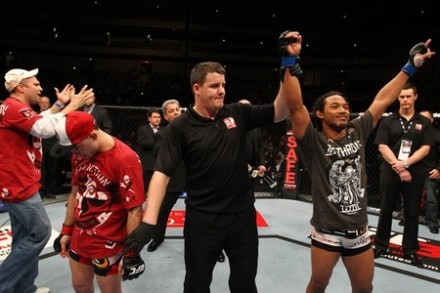
So what's the point in comparing these two very different experiences that took place so close together?  I didn't massively improve my technique, conditioning or game planning in two days, nor do I think that either performance was a blip, just about being more evenly matched in terms of the ability of my training partners.

The point of this post is to highlight the importance of being able to '... meet with Triumph and Disaster, And treat those two impostors just the same' that is to dwell on neither as of themselves, but to using them as experiences for learning and moving forward.  Anyone who watches sports of any kind will probably have heard fighters, players, managers, coaches follow a loss with the truism "We learn from it and move on".  Easy to say, and much easier in a non-competitive arena (training) than in a competitive one (a fight).  Having said that I feel I can add a little to the conversation without being too melodramatic.  I felt pretty miserable after what I'll refer to as my poor performance; essentially I felt like I'd been shown my true level and that I'd been deluding myself thinking that, with a little fine tuning, I could do myself justice in a fight.  As such, even on the way home from the gym I could feel negative thoughts and self-talk creep in.  "What's the point?" is often the first one in to my head, questioning whther I'll ever get where I want to go, whether I've got what it's going to take.  The first step for me in this is recognising what's going on - it's a reaction rather than a response, it's not based on reasoned thinking and should be acknowledged as such.  Once I can stop the reactive thoughts I can take some time to go back through to learn.  I like to take a solution focused approach - not 'why did it happen?', rather 'what can I do to improve or prevent the same happening again?'.  Sometimes it's not enough to have these conversations in my head, I'll write down the questions and answers in my notebook.  I'm a big believer in the expression 'I know what I believe when I hear myself say it' - or in this case see it written down.
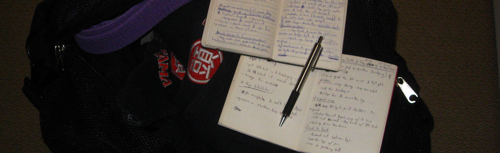
Photo from jiujitsuvortex.com


How about meeting with Triumph?  I feel that it's just as important to not get carried away will victories however large (UFC Belt) or small (a good training session).  In the same way that I could feel the negativity creeping in on the way home, so I could feel almost euphoria sneaking in to my head after two good sessions.  What's wrong with this?  Nothing as long as I recognise it for what it is and examine the experience in a rational, useful way.  The opposite side of the coin to negativity is a feeling of invincibility or an over-estimation of one's ability.  Put like that it easy to see the need to rein it in a little.

So, to sum up:
  1. Learn to recognise thoughts for what they are.
  2. Challenge them.
  3. Use a solution focused approach (What works? What's gone well? How can I do more of that? What can I do that will help? Who else can help?)
  4. Talk it through or write it down.
  5. Put it in to practice
  6. Review.
Hopefully this is helpful, I'm already writing a bigger piece along similar lines.  If you've read this far, please leave a comment or drop me a line to tell me what you think.

Saturday, January 12, 2013

How was it for you? 2012 in review


Short of something original to write about I thought I'd jump aboard the bandwagon of looking back and reviewing the last year, obviously from the point of view of all things training and what I'm trying to achieve. I guess that this can be a useful practice although I've always been fond of the driving analogy – you need to look in the rear view mirror from time-to-time but it's best to keep your eyes on the road ahead. Anyway, with that said here's my review of the year....


The biggest step that I took in 2012 in terms of fighting before I'm forty was returning to Leicester Shootfighters. In the last year others at the gym have asked me at least half-a-dozen times how long I've been training – and no, not in a 'you're really good you must have been training for ages!' way either. This led me to think about how long – on and off – I have been training, coming to the conclusion that 2013 will be ten years since I first started training at LSF. It should go without saying that although I've followed the club around, from DeMontfort Uni to Western Road (if I remember rightly), Urban Martial Arts to Gannon's, I've had long stretches with no training at all. I don't think I attended more than one session between 2008 and 2012 which, in my experience, is easily long enough to forget most of what you've learnt.

Was I nervous about going back? A little is the short answer. Not because I was worried about being hurt or worried about the fighting aspect, more because I was concerned about not being able to keep up and embarrassing myself. One thing I did remember from previous training was that wrestling in particular is tough, and no matter how much you push yourself it's nothing compared to how hard a training partner(s) or coach can push you. True to form, first session back, the warm up was uncomfortable but it didn't put me off, and a session on side control that wasn't totally alien to me encouraged me and, something that can't be stressed enough, the atmosphere at LSF is always friendly which also encourages persistance in training.
Something else that's been really useful has been using a training notebook to record techniques and other aspects of training. The act of recording what I've learnt helps to cement things in my memory, plus I'm able to 'revise' later in order to remind myself or brush up on techniques.
In thinking about my development/improvement over the year I feel that I have managed to retain a lot of what I've been taught although a key element for me over the coming months is to start to spar more so that I can try/implement things that I've learnt.  If there's an area of my game in which I've 'got' less it's takedowns and this is something that I know I'm going to need to improve on (aside from everything else that needs improvement).
Returning to LSF has been the right decision for me and I believe the right decision in order to achieve my goal.


 Getting in to better condition was and is a key goal. This year I've put a lot more time in to conditioning than I have at any point in the past. I've never previously found conditioning to be particularly interesting and finding methods I enjoy or can at least tolerate has been key to getting more of this kind of work in.  I've done a lot of circuits this year changing them up and mixing in new exercises whenever things get stale.  The net's been a great source of ideas and I've also pulled a few things from the circuits that we've done at LSF.  I've kept up the sled dragging although to a lesser extent than previously, mainly due to the fact that the field I used to train in is now off limits.  I now drag the sled on a farm road generally combining a slow half-mile pull followed by 8 -10 sprints covering the same distance.   I've also added in some unloaded sprints.  I guess the thing I've learnt this year is that conditioning can be interesting and....Fun!


Thinking about the strength component of my training I was tempted to write it off a little due to the fact that I haven't made any gains in terms of my numbers on the the four main lifts. However, considering it further I took a more positive view - I have been way more consistent with my strength training than previously and I really feel that that 5/3/1 has been an excellent method of programming for me. There's very little (none?) wasted time in this programme and as I've written previously, having all my lifts set out in advance takes all the guesswork and the "I don't feel like squatting today" out of training. I'm pleased with my consistency and considering that strength isn't a primary or even secondary concern my progress is ok.
Assessing my chances of achieving a reasonable performance in an amateur fight this year I'm 80% sure I can do it. The key bits I need to add are pretty apparent to me now and I'll write some more on those next time. Happy New Year.

Friday, December 21, 2012

Leverage Grappling System Seminar Reviews - Part 2: Half Guard


One month on from the side control seminar the Leverage Fundamentals Open Guard + Passing seminar was running at Leicester Shootfighters.  I was very interested in attending this but the lure of Terror playing in Nottingham that night was just too great.....


Anyhow, the following seminar came up pretty quickly and I decided that I couldn't afford to miss another (it's my aim to attend all six) booking in as soon as it was announced.  This was the final session in the Fundamentals series and covered the half guard and "extras" on which more later...
The half guard portion of the seminar was split in to bottom and top sections, both covering the essentials of posture with bottom taking in transitioning to guard, taking the back and sweeps, whilst top position covered passing.  As is his method, Nathan demonstrated and coached through each step of whatever he was showing before setting people to work in pairs, coaching and correcting around the room.  It bears emphasising that a key part of Nathan's method of coaching/teaching is to break things down in to bite-sized chunks so that, for me at least, there's more chance of remembering the technique and being able to drill it.  Coupled with a very articulate manner and an understanding of his subject that is clearly deep and expansive, this makes for quality and accessible coaching.

From the off, there was a lot of detail in this seminar.  The basic 'safety' position when using half guard filled a page of my notebook with points on posture, basing the foot, the importance of blocking the crossface, getting the underhook, and on it goes........ What's more, looking back through my notebook as I write this I realise that I remember it without prompting.....mostly.  Once we'd got the posture down we started to work on improving position - getting back to closed guard or open guard.  Finally from bottom position we looked at two sweeps including the 'Old School' sweep before moving on to top position.

Again we started with posture and looked at the two main positions; Underhook & Crossface and Sit Through.  I have to confess to never really using the sit-through position previously feeling a little vulnerable when presented with the opportunity to use it.  However, the details taught by Nathan have given me more confidence in the position and in switching between that and the underhook-crossface.  We worked three passes from these two positions, one I was familiar with (if not competent!) and two others that were new to me but easily learnt and practiced and again, given some more drilling I'd be happy to try them when rolling.

The Extras...

First up was learning some flow rolling drills.  Flow rolling - and forgive me if this isn't the best explanation - is non-competitive, non-strength-based, rolling for position with the emphasis on smooth transition rather than speed, and compliance rather than competition.  In order to do this  Nathan showed us two drills:
  • Passing guard - transitioning to mount - being reversed to guard - beginning again with opposite roles.
  • From being mounted - regain guard - sweep top man - transition to mount position - begin again with opposite roles.
We didn't spend a lot of time on this but I can imagine that this type of rolling can improve your transitions, your techniques and your thinking/reacting.


The final part of the day was spent looking at things that don't fit anywhere else in the Levergae system, for example, dealing with an unskilled opponent on the mat or off it in a situation that requires you to utilise some restraint rather than flatten your opponent, e.g. the friend of a friend down the pub who knows you 'do some of that UFC stuff' and wants to test you out... you get the idea.  Within this we looked at breakfalls and getting up safely, releasing wrist grips, bodylock takedowns and escapes, guillotine defence and standing and ground headlock escapes.  There's some interesting debate going on at the moment - in Jiu Jitsu Style magazine for example - about BJJ having lost some of the self-defence type elements due to the focus on sport BJJ.  It'll be interesting to see how this develops and how the ideas shape schools and styles in the future.

By the end of the five hours I was saturated and really struggling to take any more in, though to be clear, that's about me not about the seminar itself.  Once again an afternoon's top-class instruction in a friendly environment.  I can't recommend the Leverage Seminars enough.

Next up:

Sunday 20th January 2013
Fundamentals 01: Theory, Basic Skills, Mount.  (I'm already booked in for this).


10th February 2013
Leverage Submission Grappling Fundamentals Seminar 02: Side Control (Repeat)


https://en-gb.facebook.com/LeverageSG

Monday, December 3, 2012

Leverage Grappling System Seminar Reviews - Part 1

Nathan Leverton in action at NAGA European Championships

Recently I've become a bit of a seminar junkie.  In addition to the Neil Adams and Dean Lister events that I've reviewed here I've also been along to two seminars in the Leverage Grappling System Fundamentals series.  Those of you who check in here occasionally may have seen the link that I posted to Slideyfoot.com's review which went in to some considerable detail about the LGSF Closed Guard seminar. In part it was this review that made me want to check out the seminars although, obviously, as a regular student at Leicester Shootfighters I know the quality of the instruction and training on offer, especially by Head Coach Nathan Leverton whose system Leverage is.

My training time is limited so any opportunity that I get to work in more mat time I try to take.  Spending 5 hours of a Sunday focusing in detail on an aspect of the ground game seems good training economy to me, especially with my grappling needing all the work it can get and jits being such an important part of amateur MMA.

Back in October I signed up for the side-control seminar.  I've always felt comfortable in side control, it seems more stable than mount although sometimes the attacking options aren't as obvious.  This was the first Leverage seminar that I'd atttended and retaining the information  gleaned over 5 hours seemed daunting.  It's for this very reason that Nathan recommends bringing a notebook, and why wouldn't you?  You wouldn't attend any other workshop, lecture, seminar or training without some way of recording the information being imparted.

Prior to beginning Nathan distributed an agenda for the day and gave a little bit of background to the Leverage system.  Essentially, Leverage is his response to student grapplers learning techniques on an as-and-when basis, depending on what classes they attend where and at what time.  Through Leverage Nathan is presenting a system that, starting with the fundamental series, gives fighters/students/coaches a solid grounding that builds on the basics and adds in complexity going forward.  After all, what use is the Peruvian Necktie if you can't pass the guard? 

After taking us through the fundamentals of hip movement - shrimping, bridging, etc - and getting from a lying to a standing position, Nathan moved on to the top game focusing on the correct way to pin the bottom guy with side control.  The thread throughout the seminar, and, in fact, all Nathan's teaching, is the attention to detail, and it's often these details that make all the difference.   It's easy to lie across someone but to optimise your position to get real pressure through the points of contact...... that's where the details prove their worth. 


Nathan discussed the 4 positions that arms and legs can be in and the merits or otherwise of these - staggered offers better control with elbow and knee pinching hips.  We worked through under/overhook positions, the 'VW' pin and sitting through to regain control and position.  Once we'd established some competence in holding the pins we moved to transitioning to mount.

The seemingly most obvious submissions from side control are Keylock and Kimura and Nathan demonstrated both of these, again with attention paid to the details that may determine whether you get the tap or not.  The mistakes with hand/arm position that Nathan covered can be seen at pretty much every MMA event, preventing finishes from such a dominant position.  Following the armlocks we looked at the Side Choke and Nathan was able to use a bout from the previous night's UFC as an example of a common mistake being made by a very high level fighter leaving him unable to finish the submission (Nog Vs. Herman in case you're wondering).  The final submission of the day was the armbar.  I've trained transitioning from side-control to armbar before but being able to focus on it in this session has really embedded it in my mind and I can actually see myself trying it at some point.


Throughout the seminar Nathan stopped so that people could write up what they had learned.  He was also cool with people taking video as long as it's for their own use and not publicly broadcast.   I tried taking video of the teaching segments but I found that this doesn't work for me.  I may have a video to refer to afterwards but I take almost nothing in at the time!  I made two short videos and then just concentrated on watching and learning.

The final session of the day covered being pinned in side control, surviving and escape.  Starting with positional theory Nathan taught escaping to guard and to the knees.  Another key feature of Nathan's teaching, for me at least, is his emphasis on principles that are applicable in various situations.  For example, underneath side control 'framing' with the arms in order to maintain space is a key principle that also applies to half-guard (more on that in Part 2).  

The whole five hours was tiring but extremely valuable and being able to focus solely on one aspect - albeit many facets of that aspect - brought improvements in my understanding and hopefully in my game.  The quality of the instruction was awesome at any price but Leverage seminars are priced extremely reasonably.  Attending these seminars has to be one of the best ways of building or reinforcing your ground game.  I really wanted to get down to the Open Guard + Passing Seminar that Nathan taught next in the series but Terror were playing Nottingham that night so.....  I did, however, book in for the Half-Guard Seminar as soon as it was announced and I'll be posting up a review of that soon(ish).

 There will be further 'Fundamentals' seminars next year, if you love ground fighting and want some quality instruction that will impact your game, there can't be many (any?) better ways to spend a Sunday afternoon.  See you there.....

http://www.leverage-grappling.com/